Heaven/Earth/Man
Ancient Hebrew and Hangul of Federal Hwan-guk of 12 states(7199~3898 BC)

The concept of Heaven, Earth, and Humanity—Cheon-Ji-In (Cheon = Heaven, Ji = Earth, In = Humans)—is considered the first principle of philosophy during the 3,301-year Hwankuk dynasty (7199–3898 BCE), followed by the Baedal-guk era under Hwanung, which lasted 2,096 years. This idea became the foundation of all languages, expressed through symbols:
Heaven (ㅇ, sun) = “.” (天)
Earth (ㅡ) = “—” (地)
Humanity (ㅣ) = “|” (人)
These three scripts combine into a single word: Jin.

Evidence from 4,000–6,000 years ago suggests that Jews and Koreans shared cultural roots, as the word “Jin” was written using a mix of Korean and Hebrew characters since the time of Hwan-guk’s Twelve States. The word “Jin” carries three distinct meanings unified into one, though its exact pronunciation and interpretation remain unknown. Interestingly, “Ahn” (안) in Cheon-Ji-In means Heaven, and in Sumerian (around 2500 BCE), “An” was the name of the supreme god. Likewise, Ji (지) signifies Earth, and Jin relates to In (Humanity).
And showing with three scripts:

ㄷ

(H), and

大 together mean “In(Jin)”-인(人)-
man. Specially this “In(Jin)” not yet transformed as Korean script, and remain as a Hebrew alphabet. Therefore we propose that Adam in Eden saw beasts, and gave names to all. Adam not only saw the apperance of beast and fowl but also made pictograph, and these pictograph can be first ancient alphabet of Korean and Hebrew as well with other 9 tribes of 12 ferderal states.
In ancient Hebrew “A” of (Aleph, א) originates from:

, and with stick of shepherd: becomes אל(el), and it is development of

pictograph.
Also Bone carving paper(骨刻, B.C 2,500) of Shandong(昌樂 Changle), China, recently excavated is 1,000 year
earlier script than oracle bone. Shandong district is the place mainly Dongyi-Eastern(Yi) people used live, and these scripts are both Korean and Hebrew scripts.
Yuval yekutieli, Ben Gurion University of the Negev, Archaeology Department, presume a chart “The Origin of the Hebrew Alphabet” that 22 Hebrew alphabets were used around B.C 3,400 of West-Semitic. These alphabets used in Mesopotamian Near east, and those came from 12 federal states long before, and Tianshan-Pamir around B.C 3400-3200. And next further developing area was Akad-Ugarit cuniform(B.C
2,500-2,400) moved from Sinai peninsula in B.C 1,800 found together with Egypt scripts.
(z) has been used until 8 century BC in Hebrew meaning 곡괭이(鶴嘴鋤 mattock) which means food, cut, cultivate. The sound of
is Z(Za-in) of (Samaria Ostraca B.C 850). became ㄷ later days. Cantonese of South China is descendent of Dong-Yi
(夷), and read “인(人)” Yan instead Yin, but Japonic is Zin.
- (Hhet, sound hh) became H in Hebrew of 8 century BC, and it means wall, divide, outside.
(人) and 大 are exchaneable term, and original script 大 locating bottom of these two scripts(
), and three together are (+大=ㅅ+hh+ah=Zin). (Heh, ה) plus erets(ארץ) becomes ha’erets “the land”(Introduction to Ancient Hebrew, Jeff A. Benner). The script ה, Hey, has been used for 10 century BC, and
as a third script of
+大, shows (大)= ה=man 人=land-地(땅), also is Sanscrit word of “sa(house or land),” (悉曇体梵文, 600-1,200 year).
+大(zh+ah) is a mixture of ancient Hebrew and Gojoseon(with other scripts).
this Inscript of (z) and (H) and (Heh, h 人) means man and (Heh, 人)sounds “zin”
in Japonic which is transformed by Gojoseon script. Therefore, three scripts together explains “person tilling a field with a hoe.”
Heaven/Earth/Man=Cheon-Ji-In, Cheon(Heaven), Ji(Earth), In(Humans) of ancient Joseon says “three in one God” and these three script make the fomula of word construction as well as the theory of philosophy for creation and maintain the order of creatures such as combination of Heaven천 ᄋ, earth지 ᄆ —, man인 ᄉ l. In ancient
scripts of three ᄋᄋᄋmeans “three God of heaven, earth, man” and similar form of

sound gayin or “ng”, and it means “I-man” in Gojoseon(East-Yi), Hebrew, Sanscrit.
Hanyobu TaSamohae(1079 AD) of Korea dynasty proves ancient Hebrew mixture in 10-11 centry inscriptions. A Study on the Discovery of “Hanyobu TaSamohae” and Old Hangul(Changoo Lee, 2023).

The development of Proto-consonantal Hebrew as proposed by Douglas Petrovich
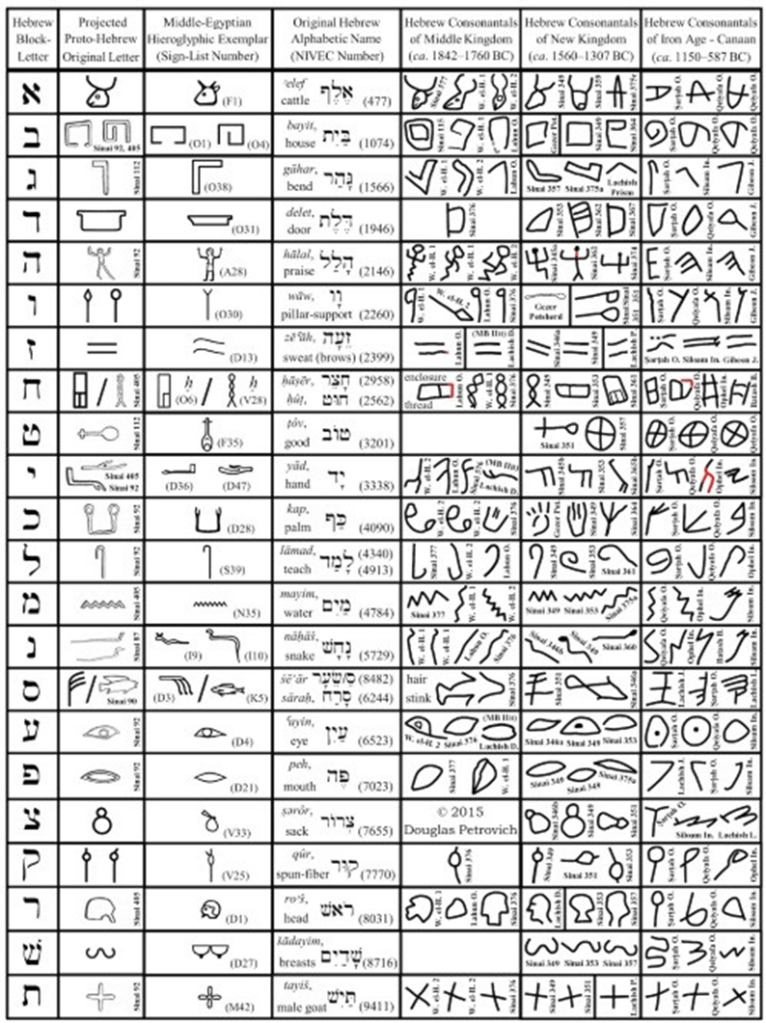
Ancient Hebrew Alphabet

(dalet -ד, D) to enter or exit through tent door
(ayin- A)an eye representing the idea of experience, together (DA) means to know.
(bet – B), house, tent, and family as well as in, with.
(nun- N) The seed is a new generation of life. (BeN) to continue the house and is a son.
(lamed – L) sheperd staff to direct the sheep,
(kaph- K) the palm of the hand. Together LaK means to walk or to go.
-> ט sound Th, means basket, store
Tsad means trail, stronghold, hunt
(quph-Q) rising sun or gather,
(resh- R) the head of a man, QaR to meet, call out.
(dalet – D) tent door,
(resh – R) the head of a man, together RaD to go down.
(Samehh ס, sin)-Grab, hate, protect.
ג Lamed a yoke as the staff on the shoulders
(Taw) Mark, sign, monument. Lamb(the Lamb of God-Jesus, or Billy Goat), it means Cross, crossed branch, Abraham went and took the ram, and offered him up for a burnt offering in stead of his son(Gen 22:13). The LORD set a mark upon Cain, lest anyone finding him should kill him(Gen 4:15). In oracle bone it means
=帝 which is the son of Heaven.
 J.B. Park
Leave a comment